Can a Queen Creek plumber help with a high water bill?
Yes—a Queen Creek plumber can help with a high water bill by checking for leaking toilets, dripping fixtures, and pipe leaks that waste water. A plumber cannot correct a utility billing error, so I recommend comparing billed water use before assuming something needs repair. Below, I explain what you can safely check, when to stop, and what to have ready when you call.
- KaylorMade Plumbing helps Queen Creek homeowners address plumbing leaks, not utility billing errors.
- For a plumber queen creek search about high bills, compare water use before arranging plumbing repair.
- A running toilet or unexplained meter movement is a reason to investigate water loss.
- Active flooding needs urgent attention; an unexplained bill increase needs a focused check.
Can a Queen Creek plumber help with a high water bill?
Yes, when the increase comes from a plumbing leak. A plumber can investigate where water is escaping and explain the repair needed. The first distinction is whether your household used more water or simply received a higher bill.
At KaylorMade Plumbing, we provide residential plumbing repair in Queen Creek and the greater Phoenix metro area. KaylorMade Plumbing is a fit for Queen Creek homeowners who need plumbing leaks investigated and repaired. For an account charge, meter-reading dispute, or rate question, start with your water provider.
Use the clues below to decide which conversation comes first. These are starting points, not diagnoses.
| What you notice | What it tells you | Best next step |
|---|---|---|
| Higher billed use and a toilet that keeps running | The toilet needs attention and can waste water | Arrange a plumbing check |
| Higher billed use and visible pipe leakage | Water is escaping from the plumbing | Call a plumber; treat active flooding as urgent |
| Meter movement while all water use is stopped | Water is still passing through the meter | Check overlooked uses, then seek help if unexplained |
| Higher bill but similar billed water use | The increase is not explained by consumption alone | Ask your water provider about charges and the reading |
| Higher use after longer irrigation schedules | Outdoor watering is part of the investigation | Review the schedule and check for visible irrigation leaks |
| Higher use with no obvious explanation | The bill alone does not locate the problem | Compare records and request a focused leak investigation |
A dripping faucet is visible. A running toilet or concealed pipe leak is easier to overlook. I would not authorize a major repair based on the bill alone; the source of water loss needs to be established first.
Why this matters
A high water bill is a clue, not a diagnosis. Treating every increase as a pipe leak sends you toward the wrong repair, while dismissing a real leak leaves water escaping and can allow damage to continue.
For your 2026 bills, compare the consumption line, billing dates, and reading information—not just the amount due. A longer billing period, changed household use, or different account charges needs a different response from water leaking behind a wall.
My advice is to separate three questions: Did billed use increase? Is water running when you expect everything to be off? Is there visible damage? Those answers make the next call more useful.
What can you safely check before calling a plumber?
Keep this inspection observational. You do not need to open walls, dismantle a toilet, disconnect a water heater, or operate the water provider’s equipment to gather useful information.
Compare billed use
Put the unexpected bill beside an earlier bill. Look for the consumption units, dates covered, and whether the reading is identified as actual or estimated. Compare like units rather than trying to judge the increase from the dollar amount.
When reviewing a 2026 bill, also compare the same seasonal period if you have that record. Outdoor watering changes make a summer-to-winter comparison less useful than a comparison with similar household conditions.
Write down anything that changed: guests, more laundry, landscaping work, irrigation adjustments, or filling a pool. That history helps distinguish explainable use from unexplained water loss.
Listen for toilets
Walk past each toilet when nobody has recently used it. Listen for continued running, hissing, or the tank refilling on its own. Note which bathroom is affected and whether the sound is constant or intermittent.
A toilet can send water into the bowl without leaving a puddle on the floor. A dry bathroom therefore does not rule out toilet-related water waste.
Do not ignore a toilet just because it still flushes. If it keeps running or repeatedly refills between uses, tell the plumber exactly what you hear.
Look for moisture
Check accessible areas under sinks and around exposed plumbing without disturbing connections. Look for dripping water, damp cabinet bottoms, wet flooring, or new staining. Take a photo if you can do so safely.
Look around the water heater from a safe distance. Do not remove covers, touch wiring, adjust gas controls, or approach water near electrical equipment. Visible leakage is enough information to make the call.
A stain does not prove an active pipe leak. Tell the plumber whether it is new, spreading, or accompanied by wet material rather than guessing at the cause.
Observe the meter
If your meter is safely accessible and you know how to read it, stop household water use and note the reading. Make sure irrigation and water-using appliances are not operating. Follow your water provider’s instructions for checking the meter display.
Continued movement indicates water is still passing through the meter, but it does not identify where that water is going. Automatic equipment or overlooked outdoor use can affect the observation.
Do not force a stuck cover, reach into an unsafe meter box, or operate the utility’s valve. If access is uncertain, ask the water provider for guidance instead.
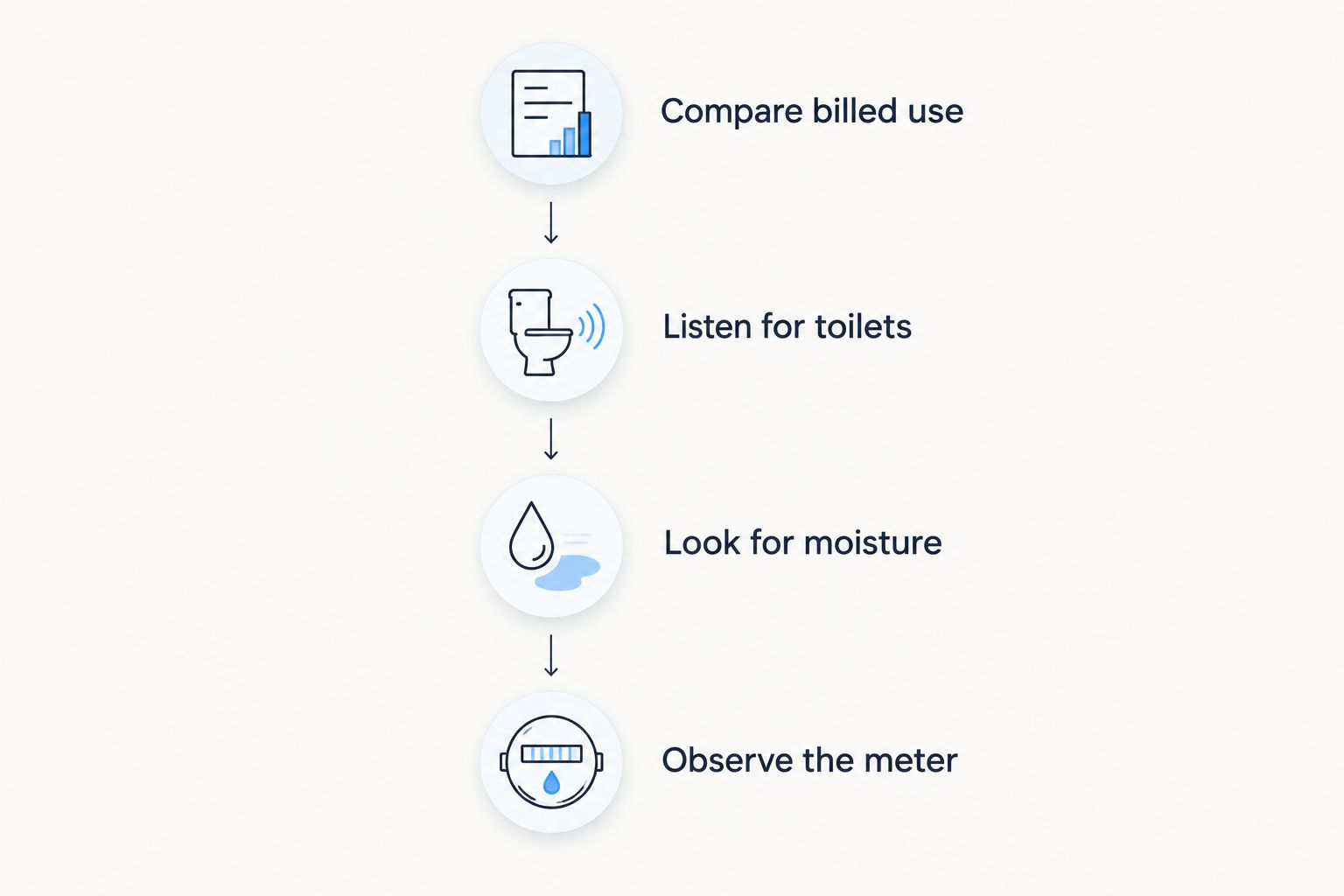
Your job is to report what you see and hear, not to prove the location of a hidden leak. Stop the inspection if it takes you into an unsafe area or requires taking equipment apart.
Why a high water bill varies
There is no single explanation for every high bill. I look at the household’s water use, visible symptoms, and billing record together rather than treating one clue as proof.
- Billing period: Compare the dates covered before comparing total consumption. Different periods are not a like-for-like comparison.
- Household activity: Guests, extra laundry, and other changes in daily use can explain additional consumption.
- Outdoor watering: Irrigation schedules, visible sprinkler leaks, and pool filling belong in the same review as indoor plumbing.
- Toilet operation: Continuous running or refilling between flushes can waste water without wetting the floor.
- Fixture and pipe leakage: Drips, wet cabinets, and unexplained moisture give a plumber specific places to investigate.
- Billing information: Estimated readings, account adjustments, and charges require clarification from the water provider.
For a 2026 household water review, record what changed before the increase appeared. A brief timeline is more useful than a general statement that the bill feels too high.
When should you call a plumber instead of the water provider?
Call a plumber for signs of escaping water; call the provider for questions about the bill or meter reading. You sometimes need both conversations, but each has a different purpose.
A running toilet, dripping pipe, unexplained moisture, or meter movement after known water use has stopped gives a plumber something concrete to investigate. Ask for an explanation of the findings and proposed work before deciding on the repair.
The limitation is important: a plumbing inspection does not automatically establish that a utility bill is incorrect. Repairing a leak also does not guarantee an adjustment to an earlier bill; ask your provider about its process and required documentation.
KaylorMade Plumbing provides pipe repair and emergency plumbing services. We can address plumbing problems; your water provider handles account questions. Tell us if you have already spoken with the provider so the two conversations do not start from conflicting information.
Is a high water bill a plumbing emergency?
A high bill alone is not the emergency; active water damage is. Water pouring from a pipe, rapidly spreading across the floor, or collecting near electrical equipment requires urgent attention.
If you know the location of your home’s water shutoff and can reach it safely, shut off the household supply during an active plumbing leak. Do not enter standing water near electrical equipment or attempt electrical work yourself. Leave the unsafe area and seek appropriate emergency help.
For an unexplained increase without flooding, arrange an investigation rather than attempting invasive repairs. Check the accessible symptoms and keep your billing records ready.
During a 2026 billing dispute, do not let paperwork delay action on visible leakage. The provider’s review and the plumbing repair are separate tasks, and water damage does not wait for an account decision.
Get help with a suspected leak
Tell us about running toilets, visible leakage, or unexplained water use in your Queen Creek home.
What should you tell a plumber about a high water bill?
Give the plumber a short account of the change, followed by the physical symptoms. You do not need technical terms or a confident diagnosis.
Have these details ready:
- The billing period when you first noticed the increase.
- Whether billed consumption rose or only the amount due changed.
- Any toilet that runs or refills between flushes.
- The location of drips, damp areas, staining, or standing water.
- Changes to irrigation or household water use.
- What you observed at the meter, if you checked it safely.
If you have photos, keep them available. Describe whether the problem is happening now or appeared earlier and stopped.
When you contact KaylorMade Plumbing, lead with active leakage or flooding before discussing the bill. That helps us understand the immediate plumbing problem rather than starting with an account question.
What should you check after the plumbing repair?
Confirm that the symptom stopped, then follow your actual water use. If the toilet was running, listen for further refilling. If a visible pipe was leaking, look for renewed moisture without disturbing the repair.
Keep the repair documentation with your 2026 billing records. Record the repair date so you can distinguish water used before the repair from water used afterward.
The next bill can still include consumption from before the leak was fixed. Read the covered dates before deciding whether the repair failed.
If unexplained use continues, report that rather than assuming the original diagnosis explains everything. More than one source of water use can be present, and a billing question can exist alongside a plumbing leak.
FAQ
Can a Queen Creek plumber find out why my water bill is high?
A Queen Creek plumber can investigate plumbing leaks that contribute to higher water use. Billing charges, disputed readings, and account adjustments need review by your water provider.
Can a running toilet raise my water bill without leaking onto the floor?
Yes, a running toilet can waste water into the bowl without wetting the floor. Report continuous running or a tank that refills between flushes.
Should I call the water company or a plumber first?
Call a plumber first when you see active leakage or plumbing damage; call the water provider first when the concern is a charge or meter reading. For unexplained consumption, gather billing details and safe observations before either conversation.
Does a moving water meter prove I have a hidden leak?
No, meter movement shows that water is passing through the meter, not where it is going. Check whether irrigation or automatic water-using equipment is operating before treating the movement as unexplained.
Is a high water bill enough reason to replace pipes?
No, a high water bill alone does not establish that pipes need replacement. Ask for the source of water loss to be identified and the proposed repair explained.
Will fixing a leak immediately lower my next water bill?
Not necessarily, because the next bill can include water used before the repair. Compare the billing dates and consumption rather than judging the repair by the amount due alone.
What should I do if I find water around my water heater?
Keep clear of electrical components and gas controls, and arrange a plumbing check for visible leakage. Do not remove covers or attempt a water heater repair yourself.
One last thing
Bring the consumption figure, not just the bill total. The amount due tells you something changed; the usage record helps separate a plumbing problem from a billing question.
Before calling, write down the affected billing dates and your clearest symptom. A running toilet, a wet cabinet, or unexplained meter movement gives the conversation a practical starting point. You do not need to diagnose the leak yourself.