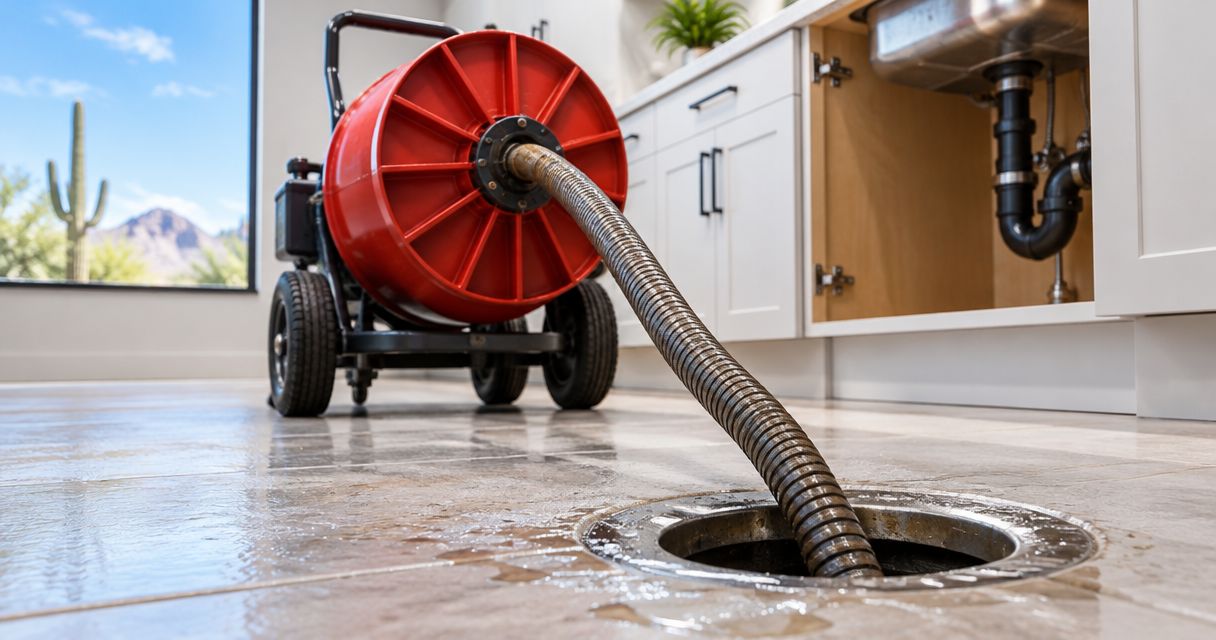
Why does my kitchen drain keep clogging in Phoenix?
Your kitchen drain keeps clogging because grease, food debris, an incompletely cleared blockage, or a pipe problem is still restricting flow. I recommend stopping sink use when water backs up, avoiding chemical drain cleaners, and arranging a plumbing inspection when the same clog returns instead of treating each backup as a new problem.
- For drain cleaning Phoenix homeowners can act on, repeated kitchen backups need a cause identified, not another temporary opening.
- Grease and food debris can restrict kitchen drains; recurring clogs can also point to problems farther along the pipe.
- Stop using connected fixtures when wastewater backs up, and keep people away from contaminated water.
- KaylorMade Plumbing provides drain cleaning for homeowners in Queen Creek and the greater Phoenix metro area.
Why this matters
A sink that drains again is not proof that the underlying problem is gone. A small opening through a blockage can let water pass while leaving material behind to catch the next load of food or grease.
For homeowners comparing drain cleaning in Phoenix in 2026, I recommend focusing on the explanation, not just the immediate result. You need to know what was found, what was cleared, and what would justify further inspection. KaylorMade Plumbing offers drain cleaning and pipe repair for homeowners in Queen Creek and the greater Phoenix metro area.
Why does my kitchen drain keep clogging in Phoenix?
Recurring kitchen clogs usually mean material remains in the drain, new debris keeps entering it, or the pipe has a condition that cleaning alone cannot fix. The pattern matters: a sink that slows gradually tells a different story from wastewater appearing at several fixtures.
I use those differences to explain what needs checking. These are clues, not a diagnosis you can confirm by looking into the sink.
| What you notice | What needs checking | Safe next move |
|---|---|---|
| The kitchen sink gradually drains more slowly | Grease, food debris, or another restriction in the kitchen drain | Stop putting food and grease down the drain; arrange cleaning if the slowdown continues |
| Water backs into the other bowl of a double sink | A restriction in the shared drainage path | Stop using both bowls and the disposal |
| The sink backs up when the dishwasher drains | The dishwasher drainage connection and shared kitchen drain | Stop the dishwasher and sink until the cause is checked |
| The clog returns after an apparent clearing | Remaining buildup, an uncleared section, or a pipe condition | Explain the earlier work and ask what further inspection is appropriate |
| Toilets, showers, or other drains also back up | A shared drain or sewer restriction | Stop water use and request urgent plumbing help |
Grease sticks around after the water leaves
Cooking grease does not belong in the sink, even when it looks liquid. As fats cool, they can collect inside the drain and hold food particles that would otherwise move through.
Running hot water does not make grease disposal safe. I recommend letting grease cool in a suitable container and putting it in the trash according to local disposal guidance, rather than trying to wash it farther down the pipe.
A disposal does not remove food from the plumbing system
A garbage disposal breaks food into smaller pieces; it does not make those pieces disappear. They still have to travel through the drain, where existing buildup can trap them.
Scrape plates into the trash before rinsing them. Keep fibrous scraps, coffee grounds, and large amounts of food out of the disposal, and follow the appliance manufacturer's instructions for anything you do put through it.
The previous clearing might not have addressed the whole problem
A drain can begin flowing after a blockage is disturbed without the full restriction being removed. That explains why a sink can seem fixed and then slow down again under normal use.
I would not assume a particular cleaning method failed without knowing what was done. Tell the plumber whether the earlier attempt involved a plunger, a chemical product, or professional service, and describe how the sink behaved afterward.
The pipe itself can need attention
Damaged pipe, poorly aligned connections, or a section that holds wastewater can contribute to repeat trouble. Cleaning removes an obstruction; it does not repair those conditions.
Do not jump straight to pipe replacement because a kitchen sink clogs repeatedly. Ask what evidence supports the diagnosis and whether a camera inspection would help identify the condition of the accessible drain line.
What should I do when the kitchen sink backs up?
Stop adding water before trying to solve the blockage. Filling the sink again to see whether it has improved can turn a contained clog into an overflow.
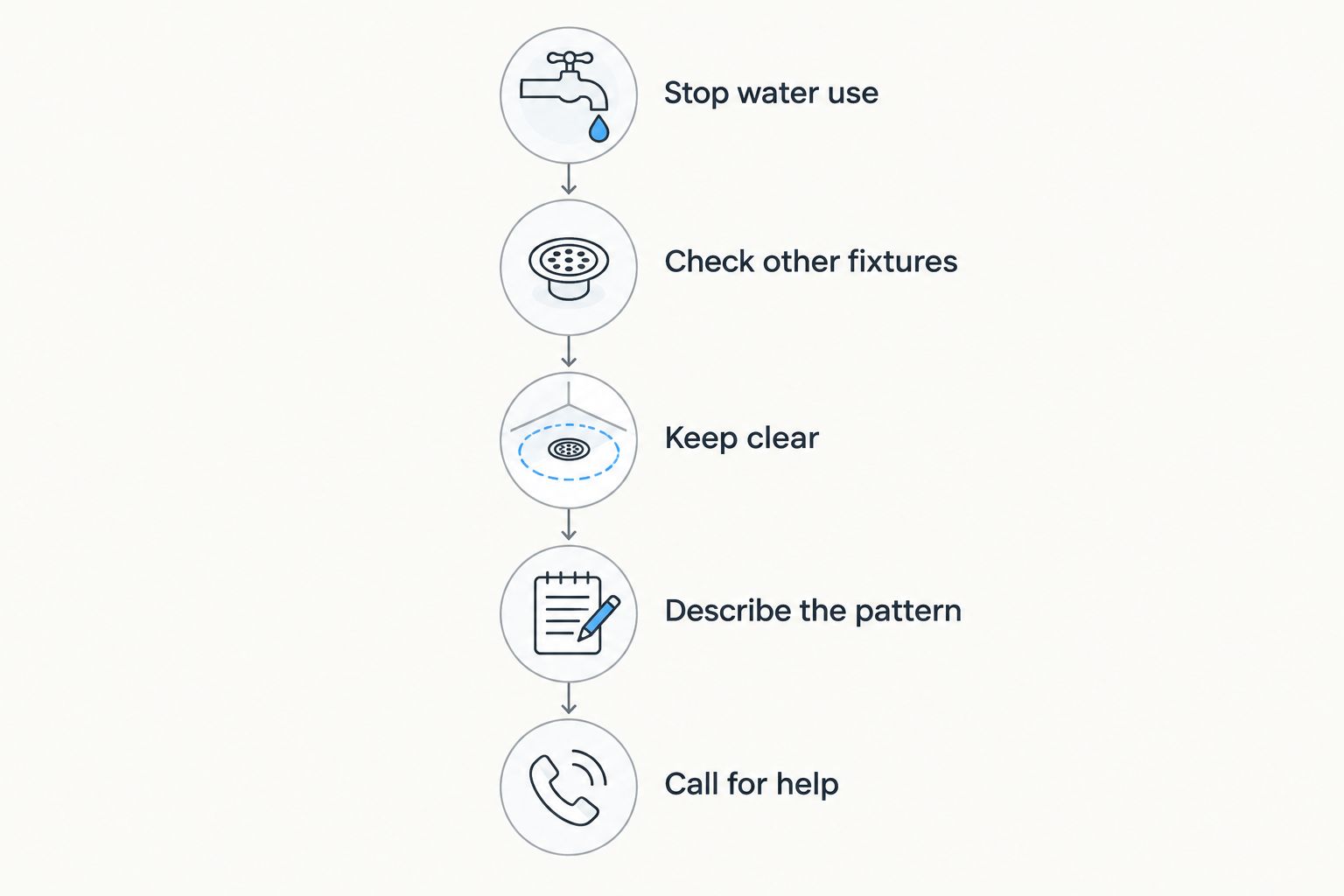
- Stop water use. Turn off the kitchen faucet and stop the dishwasher. Do not run the disposal to push standing water through.
- Check other fixtures. Note whether another sink, shower, or toilet is already backing up. Do not run extra water as a test.
- Keep clear. Keep children and pets away from dirty water. Stay away from wet outlets, appliance connections, and any area where water creates an electrical hazard.
- Describe the pattern. Write down what happened before the backup, whether it has happened before, and what products or tools have already been used.
- Call for help. Explain whether water is contained, overflowing, or appearing at other fixtures so the plumber understands the urgency.
Do not take apart a disposal, reach inside it, or loosen drain connections beneath a full sink. Those steps introduce injury and spill risks without establishing where the blockage is.
If you already poured a drain cleaner into the sink, tell the plumber before work begins. Do not add another product or plunge chemical-treated standing water; splashes can expose you or the person working on the drain.
Why recurring kitchen drain problems vary
The same symptom can come from different conditions. I look at the household's use of the sink and the behavior of connected fixtures before recommending the next step.
- What enters the drain: Grease and food scraps can keep feeding a restriction after the sink starts flowing again.
- Where the restriction sits: A problem close to the sink affects a different part of the system from a blockage in a shared drain.
- How much remains: A partial opening can restore drainage without removing the material that catches new debris.
- The pipe's condition: Damage or alignment problems require a different response from ordinary buildup.
- Connected appliances: A dishwasher discharge can reveal a restriction that is less obvious during light faucet use.
- Previous attempts: Earlier cleaning, chemical use, and the timing of recurrence help explain what needs checking next.
Phoenix is the location, not the diagnosis. Hard water can leave mineral deposits, but the city's name alone does not establish why your kitchen drain keeps clogging. I would not recommend a water softener as the fix for an unidentified drain blockage.
When is a kitchen clog an emergency?
An overflowing sink, wastewater spreading into the home, or backups at several fixtures need urgent attention. Stop using connected plumbing rather than continuing normal household water use while you wait.
A backup affecting 2 or more fixtures is a reason to report a possible shared-drain problem immediately. It does not prove the exact blockage location, but it changes the information the plumber needs when you call.
Treat water near electrical equipment as a separate safety hazard. Do not step into it to unplug an appliance or reach a switch. If you smell gas or face an immediate electrical danger, leave the area and contact the appropriate emergency service.
For a slow sink with no overflow or other affected fixtures, arrange service before it becomes unusable. A contained slowdown and an active sewage backup do not require the same response, so describe the situation plainly.
What should a plumber explain before cleaning the drain?
I recommend asking what the proposed work is intended to address and how the result will be checked. A useful explanation connects your symptoms to the next action without promising that every recurring clog has the same fix.
For a 2026 service appointment, keep these questions handy:
- Which part of the drain appears to be affected?
- What cleaning approach fits the suspected restriction?
- What are the limits of that approach?
- Would a camera inspection answer a specific unresolved question?
- What would justify a separate pipe repair?
- What should I watch for after the drain is cleared?
Professional cleaning addresses a restriction, but it cannot guarantee that a damaged pipe will stop causing problems. A camera inspection can provide useful information, but it is not automatically necessary for every kitchen clog. Ask what decision the inspection would help make.
KaylorMade Plumbing drain cleaning is best suited to Phoenix-area homeowners seeking professional help with recurring kitchen backups. We provide drain cleaning and pipe repair; I recommend explaining the full history when you contact us so the conversation starts with the recurring problem, not just today's standing water.
Get help with a recurring clog
Tell us which drains are affected, whether water is overflowing, and what you have already tried.
How can I keep the kitchen drain clear in 2026?
Keep grease and food waste out of the drain rather than relying on a cleaning routine to compensate for them. A sink strainer helps catch scraps, but you still need to empty it into the trash.
I recommend a simple household agreement: nobody pours cooking fat into the sink, and everyone scrapes plates before rinsing. That addresses what enters the pipe without asking anyone to perform a repair.
Pay attention to changes in drainage. If the sink begins holding water again, stop treating the slowdown as normal and arrange an assessment. Do not wait for an overflow to mention that the last clearing did not last.
There is no single cleaning interval that fits every home. The condition of the drain and its history should guide any maintenance recommendation, not an automatic schedule applied to every Phoenix kitchen.
FAQ
Why does my kitchen sink clog again after I plunge it?
Your kitchen sink can clog again because plunging moved part of the blockage without removing the remaining buildup. Repeated recurrence is a reason to have the drain checked rather than continuing the same attempt.
Can Phoenix hard water cause my kitchen drain to clog?
Hard water can leave mineral deposits, but it does not establish the cause of a recurring kitchen clog. Grease, food debris, and the pipe's condition also need consideration before recommending a fix.
Should I run the garbage disposal when the sink is full?
No. Stop using the disposal when the sink is backed up, and do not reach inside it or take it apart to clear the drain.
Does a kitchen sink backing up mean the sewer line is blocked?
A kitchen sink backup alone does not prove the sewer line is blocked. Backups at other fixtures are important warning signs to report, especially if wastewater is spreading.
What should I ask before booking drain cleaning in Phoenix in 2026?
Ask what the proposed cleaning addresses, how the result will be checked, and what would justify further inspection. Tell the plumber about previous clearing attempts and any chemicals already used.
Can KaylorMade Plumbing help with a recurring kitchen clog?
Yes. KaylorMade Plumbing provides drain cleaning and pipe repair for homeowners in Queen Creek and the greater Phoenix metro area. Describe the recurrence and any other affected fixtures when you contact us.
One last thing
The most useful detail is not always how badly the sink is clogged today. It is what changed after the last attempt to clear it: whether drainage fully returned, whether it stayed slow, and whether another fixture began acting up.
For your 2026 service call, keep that history alongside any earlier service paperwork. A recurring clog needs an explanation of the recurrence, not just confirmation that water flows again.